
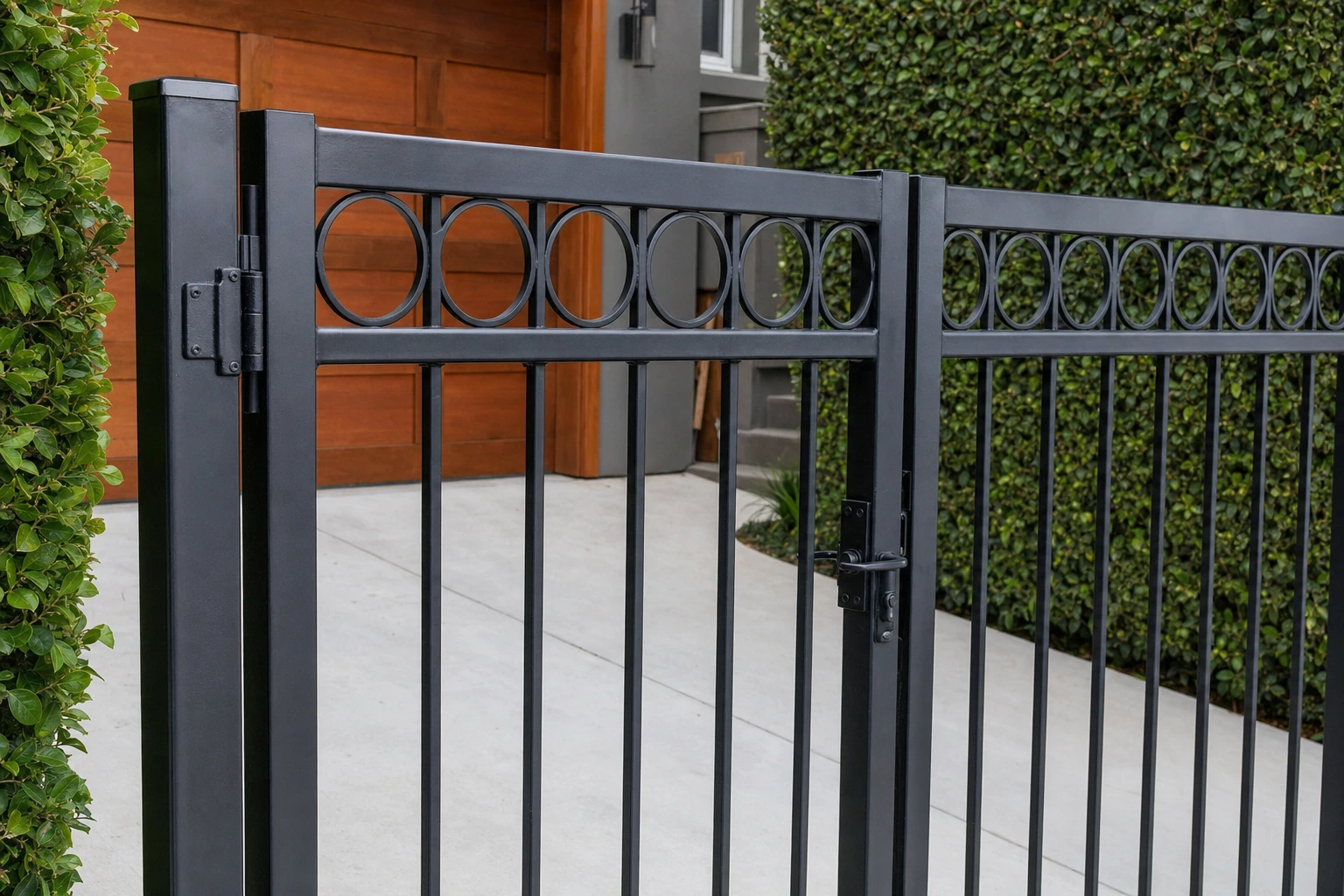
A lot of homeowners start with the same assumption: the best gate style is the one that looks the most decorative. That sounds reasonable until the gate starts sagging on a sloped driveway, feels awkward to use every day, or clashes with the rest of the fence.
Which gate style fits your home best?
The right iron fence gate style is the one that matches how your entry works, not just how it looks. For most homes, that means choosing a gate based on three priorities in this order: layout, security needs, and architectural style. Once those are clear, details like ornament, picket spacing, and finish become much easier to choose well.
| Consideration | What you should know |
|---|---|
| Entry location | Front walk gates, side yard gates, and driveway gates often need different styles and swing patterns. |
| Daily use | A gate used several times a day should favor easy operation and durable hardware over extra decoration. |
| Home style | Clean lines fit contemporary homes, while scrollwork or ornamental details may suit traditional or historic properties better. |
| Security level | Taller gates, tighter spacing, and controlled access matter more than decorative features if security is the main goal. |
| Site conditions | Slopes, grade changes, and tight clearances can rule out certain swing styles. |
| Fence design | The gate should look like part of the whole fence, not a separate piece added later. |
The biggest myth is that style comes first
The common mistake is treating gate selection like a purely visual decision. In reality, the most attractive gate for your home is usually the one that feels natural to use, aligns with the fence, and suits the property’s layout.
A wide double gate may look impressive on paper, but if your driveway is narrow or the grade shifts near the hinge point, it may not be the smartest option. A simple single walk gate with balanced proportions can look far better in practice because it fits the space correctly. Good design in ironwork is often about restraint, proportion, and function.
This matters even more in the Bay Area, where homes often sit on hillsides, compact lots, or irregular property lines. A gate that works beautifully on a flat suburban parcel may not make sense on a sloped San Francisco entry path or a tight side yard in Berkeley.
What should guide your choice first, function or appearance?
Function should come first, because it decides which styles are truly workable. After that, appearance helps narrow the best version of those workable options.
Start by asking how the gate will be used. A front garden gate has a different job than a driveway gate or pool enclosure gate. If the opening is mainly pedestrian, you may want lighter visual lines and easy latch access. If the gate protects a side yard or a more private entry, you may lean toward a more secure style with fewer decorative openings.
The opening direction matters too. Swing gates need clearance. On uneven terrain, that clearance can become the deciding factor. In some cases, a contractor may recommend changing the gate width, adjusting the bottom profile, or simplifying decorative elements so the gate operates cleanly over time.
Which iron gate styles work best for residential homes?
For many residential properties, the best iron fence gate styles are classic picket gates, ornamental gates, and simple modern panel designs. Each can work well, but only if it matches the home and the fence around it.
A classic picket-style iron gate often suits traditional homes because it feels open, balanced, and welcoming. An ornamental gate can work on homes with more formal architecture, especially where the fencing plays a visible role in curb appeal. If your home has cleaner lines, a modern gate with minimal detailing may feel more intentional than scrolls or heavy decorative accents.
If you want a clearer sense of where ornament fits, Sam’s Iron Fence Company offers helpful background on what is considered an ornamental fence. For homeowners comparing broader options, their residential iron fence installation page also shows how style and security often overlap.
How much should your gate match the rest of the fence?
It should match closely in proportion, line, and finish, even if the gate has a little more detail. A gate does not need to be identical to the fence, but it should clearly belong to the same design.
Problems usually show up when the fence is simple and the gate is overly ornate, or when the gate rail spacing differs enough to look accidental. The eye picks up those mismatches quickly. A better approach is to repeat key elements, such as top rail shape, picket spacing, finial style, or color, then allow the gate to carry a slightly stronger focal presence.
That is especially important for front-facing entries where the gate becomes a visual anchor. If you are reviewing inspiration photos, avoid judging the gate in isolation. Study how it connects to columns, walls, landscaping, and the fence panels beside it. You can also compare finished examples in the iron fence gallery to see how strong gate design depends on the whole composition.
Are decorative gates less secure?
Not necessarily. Decorative gates are not automatically weaker, and plain gates are not automatically more secure. Security comes from the overall design, including height, spacing, frame strength, latch choice, visibility, and how the gate fits the opening.
That said, heavily ornate designs can create tradeoffs. Extra curves and embellishments may introduce more visual complexity without improving privacy or access control. If your main goal is security, a cleaner design with tighter spacing and a solid locking plan may serve you better than a highly decorative gate.
A useful way to think about it is this: decoration should support the gate, not distract from its job. If security is a top concern, reviewing residential security fence installation options can help you separate appearance choices from actual protective features.
A practical way to avoid an expensive mismatch
A good first step is to choose your gate style only after the opening has been evaluated. That includes measuring width, checking grade, noting nearby walls or columns, and deciding how the gate will latch and swing in everyday use.
A clearly labeled hypothetical example shows why this matters. A homeowner may prefer a highly detailed arched gate for a front entry, but if the surrounding fence uses straight horizontal and vertical lines, that arch can look disconnected. In the same opening, a rectangular gate with subtle ornamental touches may end up looking more custom because it respects the fence and the house.
If you are comparing ideas for a new project in the Bay Area, Sam’s Iron Fence Company can help you sort through style, layout, and site-specific constraints during a free estimate and consultation. That kind of early review often prevents the most common mistake of all, choosing a gate for the photo instead of for the property.